Week 1
0.25 %
1.25 kg / 500 kg
First introduction. Divide the amount around the normal routine and observe appetite, manure and normal behaviour.
Zelený Kůň · Feeding Guide
Discover a fresh green ration component, understand moisture, and learn how to introduce hydroponically grown barley fodder gradually into everyday horse care.
Every horse is unique. This practical guide combines an indicative calculation, structured observation and sources to help you ask the right questions.
A proposed four-week framework
The approximate 1% daily target is calculated from the horse's body weight using fresh, as-fed weight. It is a practical starting framework, not a clinically proven prescription.
Week 1
0.25 %
1.25 kg / 500 kg
First introduction. Divide the amount around the normal routine and observe appetite, manure and normal behaviour.
Week 2
0.50 %
2.50 kg / 500 kg
If Week 1 passed without unusual changes, increase the fresh amount gradually.
Week 3
0.75 %
3.75 kg / 500 kg
Continue daily notes and assess fresh fodder in the context of hay, pasture and the whole ration.
Week 4
1.00 %
5.00 kg / 500 kg
An indicative target framework of 1% fresh weight. This is not a universal amount for every horse.
Includes plant material and water. One kilogram cannot be exchanged directly for one kilogram of hay.
Hay, pasture or other suitable forage remains an important part of the ration.
Clean drinking water must remain freely available regardless of feed moisture.
Enter body weight and introduction stage. The result updates immediately.
Indicative daily amount of fresh fodder
5 kg
Week 4 · 1% of body weight
This calculation is a practical starting framework, not a clinically validated prescription. Adapt it to the horse and complete ration; hay or other suitable forage and clean water remain essential.
Practical, step by step
A practical guide from the first mouthful to everyday observation of condition and wellbeing.
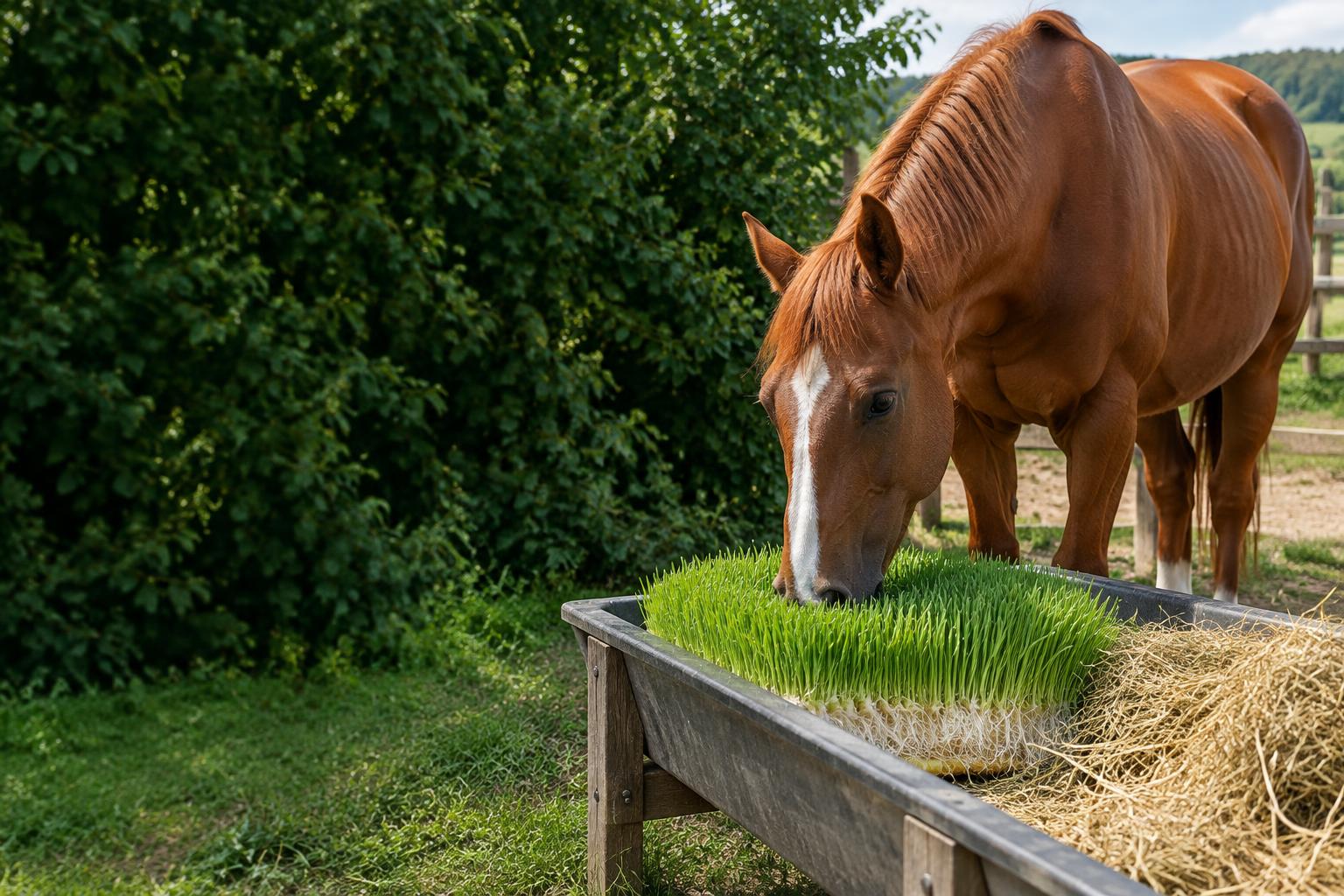
Meet the complete fodder mat: green shoots, white roots and remaining seed material.
Barley grain grows without soil in trays under controlled conditions. The fresh mat contains shoots, roots and remaining seed material.
A kilogram of fresh fodder contains considerable water, so it cannot be compared directly with a kilogram of hay. The actual dry matter and composition of the batch matter when planning the whole ration.
Start with a small amount and observe your horse across four weeks.
The proposed schedule increases fresh fodder from 0.25% to 1% of body weight daily. It is an educational framework, not a clinical-trial protocol or universal prescription.
Week three uses 0.75%: 500 × 0.0075 = 3.75 kg of fresh fodder daily. Hay or other suitable forage remains an important part of the ration.
Water in feed contributes to total intake; it does not replace drinking water.
Kathleen Crandell, PhD, comments favourably on fresh fodder's water content in The Horse. This is expert commentary, not proof that fodder improves hydration in every horse.
Hydration supports digestion, thermoregulation and performance. Clean drinking water must always remain freely available, and changes in drinking should be viewed in the context of the whole ration.
Consistent notes help distinguish a trend from a one-day impression.
Record amount, appetite, acceptance, coat and skin, normal eye appearance, alertness, energy, behaviour, drinking, manure and body condition. These are not guaranteed effects of a single feed.
Coat quality depends on overall nutrition, grooming, season and individual factors. Changes in energy or eyes can have many causes. Seek veterinary advice for unusual changes.
Fresh fodder belongs within a complete plan alongside hay, pasture and mineral nutrition.
Consider body weight, workload, age, health, hay, pasture, other feeds and mineral supplements. Fresh fodder is not an automatic kilogram-for-kilogram replacement for hay.
Batch-specific analysis helps identify dry matter, protein, fibre, starch, sugars and minerals. Without it, illustrative values must not be presented as the composition of Zelený Kůň fodder.
Turn what you have learned into a simple plan you can print and refine.
Record your horse's name, approximate weight, current hay or pasture routine, selected week, indicative amount, review dates and daily observations.
The course gives you a practical working plan. Completion is not a veterinary qualification or a professionally approved feeding prescription.
Worksheet
| Date | Amount | Appetite | Coat / eyes | Behaviour / energy | Drinking | Condition / notes |
|---|---|---|---|---|---|---|
Water contained in plant material contributes to total water intake. Moisture also explains why a kilogram of fresh fodder contains considerably less dry matter than a kilogram of hay.
The Horse article dated 6 October 2025 discusses hydroponic fodder for horses. It is expert journalism, not a controlled trial or endorsement of Zelený Kůň.The Horse · Katie Navarra ↗
Illustrative calculation only
5 kg × 82.5% = 4.13 l
At this illustrative moisture level, five kilograms of fresh fodder would contain the stated amount of water. This is not a verified analysis of the Zelený Kůň product.
Evidence in context
Each card distinguishes equine studies, hydration research, expert commentary and research in other species. Wheat is not presented as barley, and ruminant findings are not transferred to horses.
People, horses and everyday feeding
Expert perspectives and genuine experiences from people interested in fresh horse feed.
Expert perspective · not a customer review
Fresh fodder moisture is a useful characteristic to consider alongside dry matter and the balance of the complete ration.
Katie Navarra · The Horse
An expert-led magazine article about hydroponic fodder for horses. It is not a controlled trial or an endorsement of Zelený Kůň.
The Horse · 6 October 2025 ↗Do you feed fresh barley fodder to your horse? We would love to hear about your experience, feeding routine and how your horse accepts it.
Responsible feeding
Choose an amount and delivery date. We confirm the order personally, and you pay cash on delivery.
Choose a delivery date